Jump to HeaderJump to Main ContentJump to Footer
Michigan State University
ICER Institute for Cyber-Enabled Research
  • HPCC Status
  • ICER Docs

ICER Institute for Cyber-Enabled Research

  • About
    • Overview
    • News
    • Affiliations
    • Employment Opportunities
    • FAQ
    • Newsletters
    • 20th Anniversary
    Supercomputer hardware with blue and green lights and many wires connect it together.

    View and download photos of ICER's hardware.

    Photo Gallery
  • |
  • System Status
    • Overview
    • HPCC Service Status
    • ICER Status Dashboard
  • |
  • For HPCC Users
    • Overview
    • Getting Started
    • HPCC System Info
    • HPCC User Documentation
    • Buy-In Options
    • Topic of the Month
  • |
  • Research Services
    • Overview
    • Research Highlights
    • Publications
    • Citing ICER
    • Grant and Research Assistance
    • Academic Research Consulting Services
    • Opportunities and Communities
  • |
  • Training and Education
    • Overview
    • Webinars and Seminars
    • Asynchronous Tutorials
    • Classroom Support
  • |
  • Contact
    • Overview
    • Directory
ICER Institute for Cyber-Enabled Research
  • About
  • System Status
  • For HPCC Users
  • Research Services
  • Training and Education
  • Contact

< About

  • Overview
  • News
  • Affiliations
  • Employment Opportunities
  • FAQ
  • Newsletters
  • 20th Anniversary
Supercomputer hardware with blue and green lights and many wires connect it together.

View and download photos of ICER's hardware.

Photo Gallery

< System Status

  • Overview
  • HPCC Service Status
  • ICER Status Dashboard

< For HPCC Users

  • Overview
  • Getting Started
  • HPCC System Info
  • HPCC User Documentation
  • Buy-In Options
  • Topic of the Month

< Research Services

  • Overview
  • Research Highlights
  • Publications
  • Citing ICER
  • Grant and Research Assistance
  • Academic Research Consulting Services
  • Opportunities and Communities

< Training and Education

  • Overview
  • Webinars and Seminars
  • Asynchronous Tutorials
  • Classroom Support

< Contact

  • Overview
  • Directory
  • HPCC Status
  • ICER Docs
ICER > Research Services > Folder of Research Highlights >

The Study of Evolution in Artificial Organisms
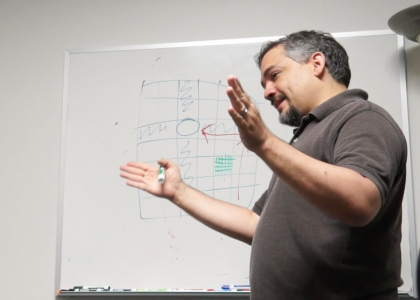
The Study of Evolution in Artificial Organisms

Charles Ofria

Dr. Ofria’s research group explores Computer Science and Evolutionary Biology to help understand fundamental concepts in each field. His group writes self-replicating computer programs and puts them into a computational environment that subjects the programs to mutations and natural selection. The digital organisms then evolve in different and exciting ways, providing a testing environment for understanding the basic principles of Evolutionary Biology. Results from this research can be applied to computational and engineering problems.

Dr. Ofria is interested in understanding biological complexity, asking questions such as: How do organisms learn to navigate, and how they acquire first simple, and then complex, tasks? For example, one member of Dr. Ofria’s group is studying how a program which begins with only the ability to copy itself, can eventually develop a memory to aid in tasks like navigation. These navigation programs evolve in a virtual environment and have been successfully downloaded into mobile robots that are able to follow a light gradient (similar to E. Coli following glucose gradient in a petri dish).

It is common to find examples of how an organism can make small improvements that result from a series of incremental changes. However, it is difficult to find examples of how evolution can make what appear to be large, one-time jumps. Organisms are often described as having irrevocably complex structures that could not have occurred using small incremental steps. However, Ofria’s group has shown that organisms can re-purpose code originally designed for completely different tasks and that they can make these one-time jumps predictably in his artificial environment.

Dr. Ofria’s group has always used High Performance Computing in their research and, previous to the existence of the HPCC, built their own systems. However, since the inception of the HPCC, their group has been able to use both more and faster processors for their research, which has encouraged more parallelization in their research.

Dr. Ofria’s group presently consists of about 20 graduate students and postdocs, all of whom work at some level with the High Performance Computing Center.

Dr. Ofria and his colleagues recently have received a prestigious NSF Science and Technology Center grant. Their center, called BEACON, combines researchers from five different universities to study Computer Science, Evolutionary Biology and Engineering and find evolutionary solutions for solving research and real-world problems.
 

Michigan State University
  • Documentation Homepage
  • HPCC Service Status
  • ICER Newsletter

Contact us

Contact Form Link

Address

Biomedical & Physical Sciences Building 567 Wilson Road, Room 1440 East Lansing, Michigan 48824-1226

Follow Us

  • Visit our Facebook page
  • Visit our page on X
  • Visit our Instagram page
  • Visit our LinkedIn page
  • Visit our YouTube page

If you're having accessibility issues, please let us know.

Michigan State University
  • Contact Information|
  • Site Map|
  • Privacy Statement|
  • Site Accessibility|
  • Call MSU: (517) 355-1855|
  • Visit: msu.edu|
  • Notice of Nondiscrimination|

SPARTANS WILL|© Michigan State University|