Jump to HeaderJump to Main ContentJump to Footer
Michigan State University
ICER Institute for Cyber-Enabled Research
  • HPCC Status
  • ICER Docs

ICER Institute for Cyber-Enabled Research

  • About
    • Overview
    • News
    • Affiliations
    • Employment Opportunities
    • FAQ
    • Newsletters
    • 20th Anniversary
    Supercomputer hardware with blue and green lights and many wires connect it together.

    View and download photos of ICER's hardware.

    Photo Gallery
  • |
  • System Status
    • Overview
    • HPCC Service Status
    • ICER Status Dashboard
  • |
  • For HPCC Users
    • Overview
    • Getting Started
    • HPCC System Info
    • HPCC User Documentation
    • Buy-In Options
    • Topic of the Month
  • |
  • Research Services
    • Overview
    • Research Highlights
    • Publications
    • Citing ICER
    • Grant and Research Assistance
    • Academic Research Consulting Services
    • Opportunities and Communities
  • |
  • Training and Education
    • Overview
    • Webinars and Seminars
    • Asynchronous Tutorials
    • Classroom Support
  • |
  • Contact
    • Overview
    • Directory
ICER Institute for Cyber-Enabled Research
  • About
  • System Status
  • For HPCC Users
  • Research Services
  • Training and Education
  • Contact

< About

  • Overview
  • News
  • Affiliations
  • Employment Opportunities
  • FAQ
  • Newsletters
  • 20th Anniversary
Supercomputer hardware with blue and green lights and many wires connect it together.

View and download photos of ICER's hardware.

Photo Gallery

< System Status

  • Overview
  • HPCC Service Status
  • ICER Status Dashboard

< For HPCC Users

  • Overview
  • Getting Started
  • HPCC System Info
  • HPCC User Documentation
  • Buy-In Options
  • Topic of the Month

< Research Services

  • Overview
  • Research Highlights
  • Publications
  • Citing ICER
  • Grant and Research Assistance
  • Academic Research Consulting Services
  • Opportunities and Communities

< Training and Education

  • Overview
  • Webinars and Seminars
  • Asynchronous Tutorials
  • Classroom Support

< Contact

  • Overview
  • Directory
  • HPCC Status
  • ICER Docs
ICER > Research Services > Folder of Research Highlights >

Simulating Oxygenated Molecule Properties for Improved Biofuel Production
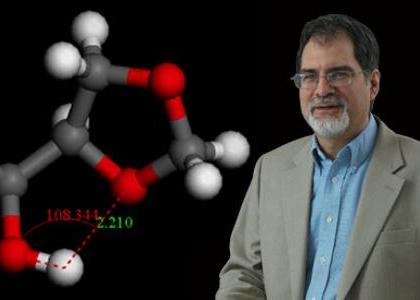
Simulating Oxygenated Molecule Properties for Improved Biofuel Production

Portrait of Carl Lira 

Dr. Carl Lira, a professor in the Department of Chemical Engineering at Michigan State University, simulates oxygenated biofuel and bio-derived chemicals. Dr. Lira notes that after over a century of research, scientists understand many of the properties of petroleum-derived compounds. However, less is known about the properties of biologically derived compounds that incorporate more oxygen in their structure, such as biofuels.

The U.S. burns approximately 55 million gallons of gasoline per day and another 17 million gallons of diesel (http://www.eia.doe.gov). Dr. Lira is interested in the design and use of bio-derived chemicals and fuels to help eliminate our dependency on these limited, fossil-based oil sources. Dr. Lira’s research group uses simulations to predict properties of chemicals based on their molecular structure. He is interested in derivatives and by-products from common processes. For example, the traditional process of producing bio-diesel results in a 10% byproduct of glycerol that does not burn well and must be removed from the bio-diesel. Glycerol can be used for other applications, but it is expensive to purify. Dr. Lira’s team is researching methods to convert glycerol into a mixture of acetals, with the goal of transforming the glycerol into a byproduct can be cleanly burned within the bio-diesel – a breakthrough that could increase the of useful fuel from the process by 10%. However, property information for the acetals is scarce. By simulating compounds where ample property information is available, the team then transfers the molecular parameter information to predict properties for new molecules such as the acetals.

Dr. Lira works with the MSU Fuels Team and uses the HPCC to conduct molecular-dynamics and Monte-Carlo simulations of highly oxygenated substances. These simulations estimate important properties such as vapor pressure, density and surface tension of the proposed fuels. Dr. Lira uses the simulations to complement and extend experimental work with the fuels team. The HPCC has enabled Dr. Lira to start work in an area where funding is limited without prior simulation results.

The MSU Fuels Team is currently funded by the DOE, USDA and MEDC.
 

  • Documentation Homepage
  • HPCC Service Status
  • ICER Newsletter

Contact us

Contact Form Link

Address

Biomedical & Physical Sciences Building 567 Wilson Road, Room 1440 East Lansing, Michigan 48824-1226

Follow Us

  • Visit our Facebook page
  • Visit our page on X
  • Visit our Instagram page
  • Visit our LinkedIn page
  • Visit our YouTube page

If you're having accessibility issues, please let us know.

  • Contact Information|
  • Site Map|
  • Privacy Statement|
  • Site Accessibility|
  • Call MSU: (517) 355-1855|
  • Visit: msu.edu|
  • Notice of Nondiscrimination|

SPARTANS WILL|© Michigan State University|