Jump to HeaderJump to Main ContentJump to Footer
Michigan State University
ICER Institute for Cyber-Enabled Research
  • HPCC Status
  • ICER Docs

ICER Institute for Cyber-Enabled Research

  • About
    • Overview
    • News
    • Affiliations
    • Employment Opportunities
    • FAQ
    • Newsletters
    • 20th Anniversary
    Supercomputer hardware with blue and green lights and many wires connect it together.

    View and download photos of ICER's hardware.

    Photo Gallery
  • |
  • System Status
    • Overview
    • HPCC Service Status
    • ICER Status Dashboard
  • |
  • For HPCC Users
    • Overview
    • Getting Started
    • HPCC System Info
    • HPCC User Documentation
    • Buy-In Options
    • Topic of the Month
  • |
  • Research Services
    • Overview
    • Research Highlights
    • Publications
    • Citing ICER
    • Grant and Research Assistance
    • Academic Research Consulting Services
    • Opportunities and Communities
  • |
  • Training and Education
    • Overview
    • Webinars and Seminars
    • Asynchronous Tutorials
    • Classroom Support
  • |
  • Contact
    • Overview
    • Directory
ICER Institute for Cyber-Enabled Research
  • About
  • System Status
  • For HPCC Users
  • Research Services
  • Training and Education
  • Contact

< About

  • Overview
  • News
  • Affiliations
  • Employment Opportunities
  • FAQ
  • Newsletters
  • 20th Anniversary
Supercomputer hardware with blue and green lights and many wires connect it together.

View and download photos of ICER's hardware.

Photo Gallery

< System Status

  • Overview
  • HPCC Service Status
  • ICER Status Dashboard

< For HPCC Users

  • Overview
  • Getting Started
  • HPCC System Info
  • HPCC User Documentation
  • Buy-In Options
  • Topic of the Month

< Research Services

  • Overview
  • Research Highlights
  • Publications
  • Citing ICER
  • Grant and Research Assistance
  • Academic Research Consulting Services
  • Opportunities and Communities

< Training and Education

  • Overview
  • Webinars and Seminars
  • Asynchronous Tutorials
  • Classroom Support

< Contact

  • Overview
  • Directory
  • HPCC Status
  • ICER Docs
ICER > Research Services > Folder of Research Highlights >

Nonradiative Recombination
Nonradiative Recombination

The Levine Group 

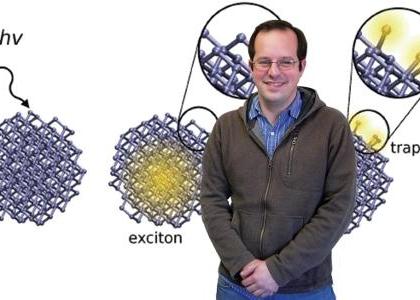
The Levine group applies iCER’s high-performance computer resources to identify the mechanism of one process that limits the efficiency of solar cells: nonradiative recombination. It is their hope that by elucidating the mechanism of this process they can inform the design of future generations of materials with desirable properties for solar energy harvesting and other applications.

When a material absorbs light, electrons in the material become excited. In the course of its motions, an excited electron interacts with the nuclei of the atoms in the material. Under some circumstances, the energy in the excited electron can be transferred to the nuclei. That is, the electrical energy that could have been used to power an electric device or drive a chemical reaction has been lost as heat. This process is nonradiative recombination, and in the context of a solar cell it results in a loss of efficiency. The details of the “dance” performed by the electrons and nuclei in such a material are complex and very difficult to measure experimentally.

Computer simulations allow researchers to observe the microscopic atom-by-atom, electron-by-electron dynamics of this process in a way that is not possible in the laboratory, and thus can shed light on how future generations of materials should be designed.

Through the use of graphics processing units (GPUs), fast processors designed to accelerate graphical applications, they hope to significantly expand the size and complexity of photochemical systems that can be practically studied. As individual GPUs offer the performance of a small cluster of traditional CPUs, ICER’s GPU cluster offers Levine the opportunity to ask the question: “what would we do if we had a cluster of clusters?” The answer is to run multiple coupled simulations of nonradiative processes in materials, with the hope of fully exploring their possible decay mechanisms.
 

  • Documentation Homepage
  • HPCC Service Status
  • ICER Newsletter

Contact us

Contact Form Link

Address

Biomedical & Physical Sciences Building 567 Wilson Road, Room 1440 East Lansing, Michigan 48824-1226

Follow Us

  • Visit our Facebook page
  • Visit our page on X
  • Visit our Instagram page
  • Visit our LinkedIn page
  • Visit our YouTube page

If you're having accessibility issues, please let us know.

  • Contact Information|
  • Site Map|
  • Privacy Statement|
  • Site Accessibility|
  • Call MSU: (517) 355-1855|
  • Visit: msu.edu|
  • Notice of Nondiscrimination|

SPARTANS WILL|© Michigan State University|