Molecular Shields for Aerospace Materials

Modern aviation is a feat of engineering that requires a constant struggle against the physical laws of gravity and the chemical laws of degradation. For decades, the industry has sought ways to make aircraft lighter and more fuel-efficient without sacrificing the structural integrity required to transport hundreds of passengers through the upper atmosphere. This quest led to the widespread adoption of carbon fiber composites in the construction of modern fuselages and wings. These materials are incredibly strong and significantly lighter than traditional metals, but they have introduced a persistent vulnerability known as galvanic corrosion.
Ben Wenig, a first-year Ph.D. student with the Swain Research Group in the Department of Chemistry at Michigan State University, is working to address this multibillion-dollar problem by engineering molecular shields that are nearly weightless yet powerful enough to halt chemical decay.
The technical challenge arises at the microscopic level where different materials meet. While the body of a Boeing might be composed of carbon fiber, the bolts and fasteners that secure the wings to the fuselage are typically made of aluminum. When these two materials are joined, they create an unintended electrical circuit, causing the aluminum to corrode at an accelerated rate at the very points where the aircraft requires the most strength. To prevent this, manufacturers currently rely on thick anti-corrosion paints and heavy coatings. While these barriers are effective, they add thousands of pounds to an aircraft, which increases fuel consumption and raises the environmental cost of every flight.
The Innovation of Molecular Monolayers
The Swain Research Group offers a radical alternative to the heavy coatings currently used in the aerospace industry. Instead of burying the problem under layers of paint, he is investigating the use of molecular monolayers, which are single layers of molecules that are chemically grafted directly onto the surface of carbon fiber. By creating a uniform and perfectly ordered shield that is only one molecule thick, Wenig and colleagues can block the transfer of electrons between the carbon and the aluminum fasteners. This process effectively stops galvanic corrosion before it can begin, all while adding virtually no weight to the aircraft.
"We want to understand at the molecular level, through our computational and experimental results, how these molecules form on the carbon surfaces so that we can form very ordered, single monolayers," Wenig explains.
The success of this approach depends entirely on the precision of the chemical bond. If the layer has gaps or clumps in the molecular arrangement, the protection fails. "We want a single dispersed layer so there is no cracking or areas of increased corrosion," he notes. Achieving this level of perfection requires a combination of high-level chemistry and massive computational power.
High-Performance Computing as a Chemical Tool
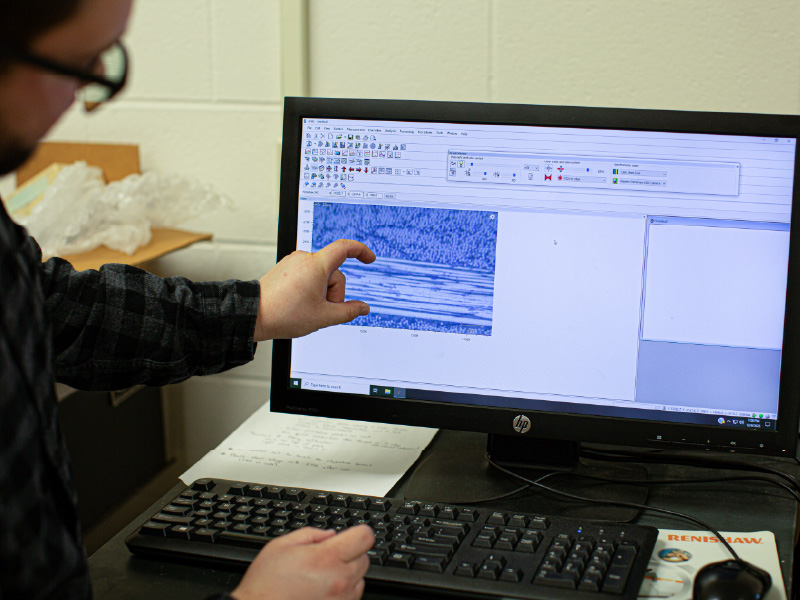
Because Wenig is working with individual atoms and molecules, he cannot simply look through a standard microscope to see if his experiments are working. Instead, he must rely on the computational resources of the Institute for Cyber-Enabled Research (ICER). Modeling the way a molecule approaches and binds to a carbon surface requires solving the complex equations of quantum mechanics. To do this, Wenig uses a computational modeling method that allows him to predict the behavior of electrons and the stability of chemical bonds. These simulations involve billions of calculations that would be impossible to perform on a standard desktop computer.
The High-Performance Computing Center at ICER has become an essential part of Wenig's research workflow. By utilizing the supercomputer, he can test dozens of different molecular structures in a virtual environment to see which ones form the strongest and most stable shields. This digital testing ground allows him to narrow down his choices before he ever begins the expensive and time-consuming process of physical synthesis in the laboratory. Wenig credits the success of his first year in the Ph.D. program to the accessibility of these resources. "I will say, ICER staff has been extremely available, helpful, and responsive," Wenig says. "We couldn't do any of this modeling without the MSU supercomputer, the HPCC, that is available to us."
Verifying Results at the Atomic Scale
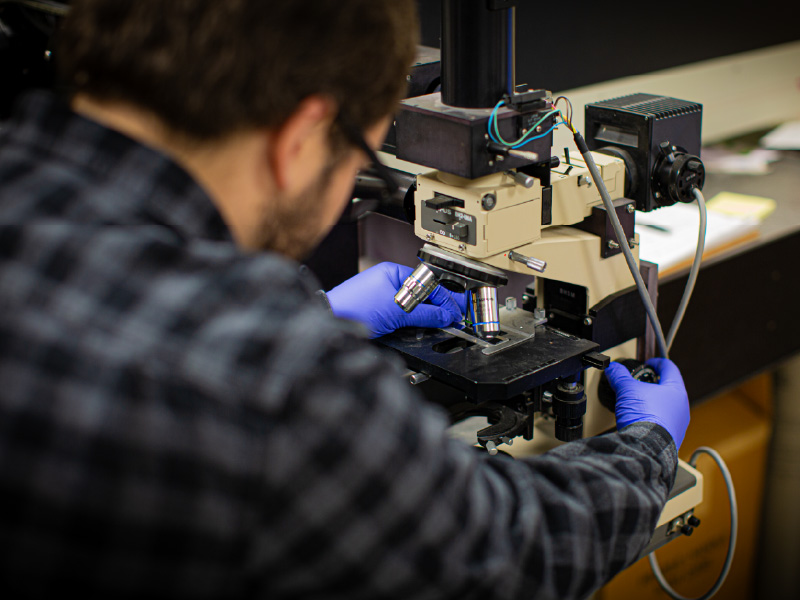
The research does not end with a computer simulation. Once the digital models identify a promising molecular candidate, Wenig transitions to the physical laboratory to verify his findings. He uses specialized equipment to inspect the surfaces he has treated. One of the most critical tools in his arsenal is the atomic force microscope. Unlike a traditional microscope, an atomic force microscope uses a tiny physical probe to "feel" the surface of the material, creating a map of the atomic landscape.
By using this microscope, Wenig can confirm whether his molecular layer is as smooth and ordered as the computer models predicted. He looks for evidence that the molecules have spread out evenly across the carbon fiber without leaving any exposed areas. This constant feedback loop between the virtual simulations at ICER and the physical measurements in the lab allows him to refine his chemical processes with a high degree of accuracy. It is this combination of theory and observation that ensures the molecular shields will be robust enough to survive the extreme pressures and temperatures of commercial flight.
A Sustainable Future for Transportation
While the immediate application of this research is focused on the aerospace industry, the broader implications for sustainability are significant. Many of the traditional anti-corrosion coatings used today contain toxic materials like chromium or lead, which pose risks to both human health and the environment during manufacturing and disposal processes. The molecular monolayers Wenig and colleagues are developing are a much cleaner alternative, utilizing far less material and avoiding the need for heavy metals. Furthermore, by reducing the weight of aircraft, this technology could help the aviation industry significantly lower its carbon emissions and fuel consumption costs.
The benefits of Wenig’s research could eventually reach far beyond the runway. "I could see this as an opportunity for car manufacturers to develop anti-corrosion coatings on a much cheaper scale," he notes. For those living in cold climates where road salt causes vehicles to degrade prematurely, molecularly grafted coatings could lead to longer-lasting and more durable cars. This would represent a major shift in the automotive industry, where corrosion is a constant battle for both manufacturers and consumers.
By solving the hidden problems of the deep molecular world, Wenig is helping to build a more efficient and sustainable future. His work demonstrates how the fusion of chemistry and high-performance computing can lead to innovations that protect our most advanced technologies while also preserving the environment. This research is financially supported by the Office of Naval Research.