Jump to HeaderJump to Main ContentJump to Footer
Michigan State University
ICER Institute for Cyber-Enabled Research
  • HPCC Status
  • ICER Docs

ICER Institute for Cyber-Enabled Research

  • About
    • Overview
    • News
    • Affiliations
    • Employment Opportunities
    • FAQ
    • Newsletters
    • 20th Anniversary
    Supercomputer hardware with blue and green lights and many wires connect it together.

    View and download photos of ICER's hardware.

    Photo Gallery
  • |
  • System Status
    • Overview
    • HPCC Service Status
    • ICER Status Dashboard
  • |
  • For HPCC Users
    • Overview
    • Getting Started
    • HPCC System Info
    • HPCC User Documentation
    • Buy-In Options
    • Topic of the Month
  • |
  • Research Services
    • Overview
    • Research Highlights
    • Publications
    • Citing ICER
    • Grant and Research Assistance
    • Academic Research Consulting Services
    • Opportunities and Communities
  • |
  • Training and Education
    • Overview
    • Webinars and Seminars
    • Asynchronous Tutorials
    • Classroom Support
  • |
  • Contact
    • Overview
    • Directory
ICER Institute for Cyber-Enabled Research
  • About
  • System Status
  • For HPCC Users
  • Research Services
  • Training and Education
  • Contact

< About

  • Overview
  • News
  • Affiliations
  • Employment Opportunities
  • FAQ
  • Newsletters
  • 20th Anniversary
Supercomputer hardware with blue and green lights and many wires connect it together.

View and download photos of ICER's hardware.

Photo Gallery

< System Status

  • Overview
  • HPCC Service Status
  • ICER Status Dashboard

< For HPCC Users

  • Overview
  • Getting Started
  • HPCC System Info
  • HPCC User Documentation
  • Buy-In Options
  • Topic of the Month

< Research Services

  • Overview
  • Research Highlights
  • Publications
  • Citing ICER
  • Grant and Research Assistance
  • Academic Research Consulting Services
  • Opportunities and Communities

< Training and Education

  • Overview
  • Webinars and Seminars
  • Asynchronous Tutorials
  • Classroom Support

< Contact

  • Overview
  • Directory
  • HPCC Status
  • ICER Docs
ICER > Research Services > Folder of Research Highlights >

Large Scale Simulation of Water and Contaminants in the Great Lakes
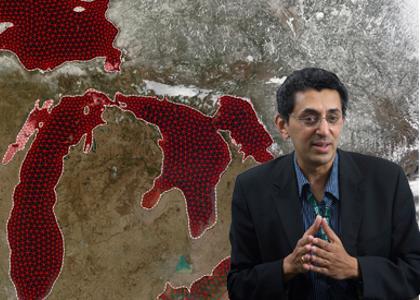
Large Scale Simulation of Water and Contaminants in the Great Lakes

Portrait of Mantha Phanikumar 

Dr. Mantha Phanikumar is a Professor in the Department of Civil and Environmental Engineering. His research uses the computational resources of the HPCC to develop models of water quality and quantity in the Great Lakes region. Dr. Phanikumar’s 3D models use millions of grid points with resolution between 10-100 meters in the horizontal direction. The variable grid size allows Dr. Phanikumar to have fine meshes at the beach level, where more detail is needed, and larger meshes (typically a kilometer or more) in the middle of the Lakes, where less detail is needed.

Modeling these water regions is no easy task, in part because there is no known set of simple variables to accurately predict events, such as the path contaminates take after an accidental spill. Such problems are extremely complex and require modeling at many scales – from the planetary scale of the Earth’s rotation to regional weather patterns and small-scale models of individual beaches, including the location, amount and type of contamination. No single process or theoretical model currently exists to combine these types of data from different modeling scales.

Although Dr. Phanikumar would like to model every detail, down to the migration of sand in the dunes, that is not currently feasible – the trick is figuring out where compromises can be made to develop models that are accurate enough to be of value. His current efforts focus on isolating the specific environmental variables and processes that can be used to predict the levels of pathogens, such as bacteria viruses and protozoa, with the goal of creating a prediction model that will help protect the public from contaminated waterways.

More details of this computational research based on HPCC facilities are available in the following papers:

1. P. Thupaki, M.S. Phanikumar, D. Beletsky, D.J. Schwab, M.B. Nevers and R.L. Whitman, Budget Analysis of Escherichia coli at a Southern Lake Michigan Beach, Environmental Science & Technology, vol. 44, no. 3, pp. 1010-1016, doi: 10.1021/es0902232a (2010)

2. C. Shen, M.S. Phanikumar, T.T. Fong, I. Aslam, S.L. Molloy and J.B. Rose, Evaluating Bacteriophage P22 as a Tracer in a Complex Surface Water System: The Grand River, Michigan, Environmental Science & Technology , Vol. 42, No. 7, pp. 2426 – 2431, doi: 10.1021/es02317t (2008)

3. L. Liu, M.S. Phanikumar, S.L. Molloy, R.L. Whitman, M.B. Nevers, D.A. Shively, D.J. Schwab, J.B. Rose, Modeling the Transport and Inactivation of E. coli and Enterococci in the Nearshore Region of Lake Michigan, Environmental Science & Technology , Vol. 40, No. 16, pp. 5022-5028, doi: 10.1021/es060438k (2006)
 

  • Documentation Homepage
  • HPCC Service Status
  • ICER Newsletter

Contact us

Contact Form Link

Address

Biomedical & Physical Sciences Building 567 Wilson Road, Room 1440 East Lansing, Michigan 48824-1226

Follow Us

  • Visit our Facebook page
  • Visit our page on X
  • Visit our Instagram page
  • Visit our LinkedIn page
  • Visit our YouTube page

If you're having accessibility issues, please let us know.

  • Contact Information|
  • Site Map|
  • Privacy Statement|
  • Site Accessibility|
  • Call MSU: (517) 355-1855|
  • Visit: msu.edu|
  • Notice of Nondiscrimination|

SPARTANS WILL|© Michigan State University|