Jump to HeaderJump to Main ContentJump to Footer
Michigan State University
ICER Institute for Cyber-Enabled Research
  • HPCC Status
  • ICER Docs

ICER Institute for Cyber-Enabled Research

  • About
    • Overview
    • News
    • Affiliations
    • Employment Opportunities
    • FAQ
    • Newsletters
    • 20th Anniversary
    Supercomputer hardware with blue and green lights and many wires connect it together.

    View and download photos of ICER's hardware.

    Photo Gallery
  • |
  • System Status
    • Overview
    • HPCC Service Status
    • ICER Status Dashboard
  • |
  • For HPCC Users
    • Overview
    • Getting Started
    • HPCC System Info
    • HPCC User Documentation
    • Buy-In Options
    • Topic of the Month
  • |
  • Research Services
    • Overview
    • Research Highlights
    • Publications
    • Citing ICER
    • Grant and Research Assistance
    • Academic Research Consulting Services
    • Opportunities and Communities
  • |
  • Training and Education
    • Overview
    • Webinars and Seminars
    • Asynchronous Tutorials
    • Classroom Support
  • |
  • Contact
    • Overview
    • Directory
ICER Institute for Cyber-Enabled Research
  • About
  • System Status
  • For HPCC Users
  • Research Services
  • Training and Education
  • Contact

< About

  • Overview
  • News
  • Affiliations
  • Employment Opportunities
  • FAQ
  • Newsletters
  • 20th Anniversary
Supercomputer hardware with blue and green lights and many wires connect it together.

View and download photos of ICER's hardware.

Photo Gallery

< System Status

  • Overview
  • HPCC Service Status
  • ICER Status Dashboard

< For HPCC Users

  • Overview
  • Getting Started
  • HPCC System Info
  • HPCC User Documentation
  • Buy-In Options
  • Topic of the Month

< Research Services

  • Overview
  • Research Highlights
  • Publications
  • Citing ICER
  • Grant and Research Assistance
  • Academic Research Consulting Services
  • Opportunities and Communities

< Training and Education

  • Overview
  • Webinars and Seminars
  • Asynchronous Tutorials
  • Classroom Support

< Contact

  • Overview
  • Directory
  • HPCC Status
  • ICER Docs
ICER > Research Services > Folder of Research Highlights >

Investigating HIV at the molecular level

Investigating HIV at the Molecular Level
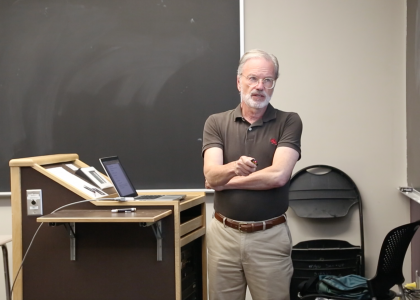
Dr. Robert Cukier 

Michigan State University Chemistry professor Dr. Robert Cukier seeks to understand how the human immunodeficiency virus (HIV) behaves at the molecular level. Working with Research Assistant Professor Dr. Steve Seibold and other collaborators, Dr. Cukier uses a technique known as molecular dynamics to look at HIV at an atom-by-atom level.

The goal is to understand how HIV behaves, for instance, when interacting with a drug. They want to see how a potential drug “docks” with the virus. For instance, they ask why a strain of HIV that has become multi-drug-resistant (MDR) is different from others.

The researchers begin with an X-ray crystallography image. “The image is like a snapshot of the virus,” says Dr. Cukier. “You can’t capture moving images using crystallography; it’s like having a single frame from a movie,” he explains. Starting with the snapshot, they use computer simulations to model how the molecule will behave when heated. They want to determine how protease “flaps” on the virus behave. “What parts of the virus fluctuate a lot, and what don’t?” he explains.

Have you ever heard of a “femtosecond?” That’s 1 to the 10 to the minus 15th of a second. That’s how fine a time slice they look at. They also analyze behavior in terms of picoseconds (1 to the 10 to the minus 12th); nanoseconds (a billionth of a second), microseconds (millionths of a second) all the way to one entire second. The goal is to try to find at what interval the fastest motion occurs.

Modeling over such a wide range of intervals produces a massive amount of data and requires an incredible amount of computational prowess. Dr. Cukier says “We’ve solving Newton’s equations and these are very expensive calculations. In theory, we’re solving a problem 10 to the 15 times.” Dr. Seibold says one modeling run used 8 processors on an SGI computer in the High Performance Computer Center (HPCC) at MSU. The program emitted intermediate results every 250 steps, so research could recover in event of a computer outage. The researchers estimate they produced a terabyte (1,000 gigabytes) of results.

The analysis took three months to complete. Obviously, computations on this scale can’t be performed on a conventional PC or workstation.

Dr. Cukier says their work is part of a larger community of researchers using molecular dynamics in biological studies. The researchers collaborate with Dr. Lad Kovari, an X-ray crystallographer at Wayne State University. The Michigan Center for Biological Information supported the research. Dr. Cukier serves as co-director of the Quantitative Biology and Modeling Center at MSU. They have published papers on their research in the Journal of Physical Chemistry.
 

  • Documentation Homepage
  • HPCC Service Status
  • ICER Newsletter

Contact us

Contact Form Link

Address

Biomedical & Physical Sciences Building 567 Wilson Road, Room 1440 East Lansing, Michigan 48824-1226

Follow Us

  • Visit our Facebook page
  • Visit our page on X
  • Visit our Instagram page
  • Visit our LinkedIn page
  • Visit our YouTube page

If you're having accessibility issues, please let us know.

  • Contact Information|
  • Site Map|
  • Privacy Statement|
  • Site Accessibility|
  • Call MSU: (517) 355-1855|
  • Visit: msu.edu|
  • Notice of Nondiscrimination|

SPARTANS WILL|© Michigan State University|