Gravitational Lensing
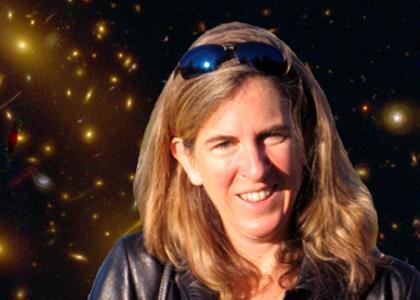
Gravitational Lensing "Two-Fer": Probing the Nature of Dark Matter and Discovering the Most Distant Galaxies in the Universe with the Hubble Space Telescope
Megan Donahue (MSU), Adi Zitrin (main GPU user, CLASH), Marc Postman (CLASH PI, STScI), and the CLASH collaboration (website)
One of the important results of Einstein's general theory of relativity is that massive, dense celestial objects act as natural magnifying lenses in the sky because of their incredible gravity. As such, the most massive objects in the universe — the clusters of galaxies — distort and magnify the light from distant galaxies located behind the clusters. This "gravitational lensing" can produce multiple images of the same background source, so that to us, the observers, the source is visible in different places in the sky, arranged around the cluster. Most of the matter in the universe is known to consist of a transparent component dubbed Dark Matter. Since dark matter is invisible, a unique way to map its distribution and learn about it is to study many examples of these “gravitational lenses.”
Dr. Donahue, her team, and the CLASH collaboration have been awarded the equivalent of one month of observing time with the Hubble Space Telescope (HST), almost 800 hours of telescope time, spread over three years, to study 25 of the most massive clusters of galaxies in the universe. By doing so, they are getting a sneak peek at the distant, early universe and its newborn galaxies, and at the same time they are learning about the dark matter inside clusters of galaxies.
The research team takes advantage of the fact that the multiple images in the HST image of a cluster originate from the same background source. The locations and distortions of the images indicate how the "lens" is bending or distorting the light that passes through. So these lensed versions of background galaxies reveal not only how much dark matter exists there, but also where dark matter is located within the cluster of galaxies. The goal is to measure this effect with as many multiple-lensed background systems as possible. Since they wish to measure exactly where dark matter is residing at a resolution similar to the resolution of NASA's Hubble Space Telescope, over a large field, manipulations of millions of pixels are required in each computational step in the search for the optimal dark matter map that describes best the observed images configuration. For this massive calculation, and using our established lens-modeling technique, they take advantage of both the Institute for Theoretical Astrophyiscs at Heidelberg University (home institution of Dr. Adi Zitrin), and the MSU HPCC machinery to perform many parallel calculations. In particular, multiple cores and the new GPU (rather than simple CPU) capabilities enabled them to speed up these massive calculations. This computational power has helped them analyze about 20 gravitational lenses, uncovering many multiple images of different sources, and producing high-end scientific results and dark matter maps. In fact, few of the farthest galaxies known to date have been found behind the clusters we analyzed, allowing a deep magnified view into the early universe.