Finding the Pattern: How Machine Learning is Helping Researchers Navigate STEM Education
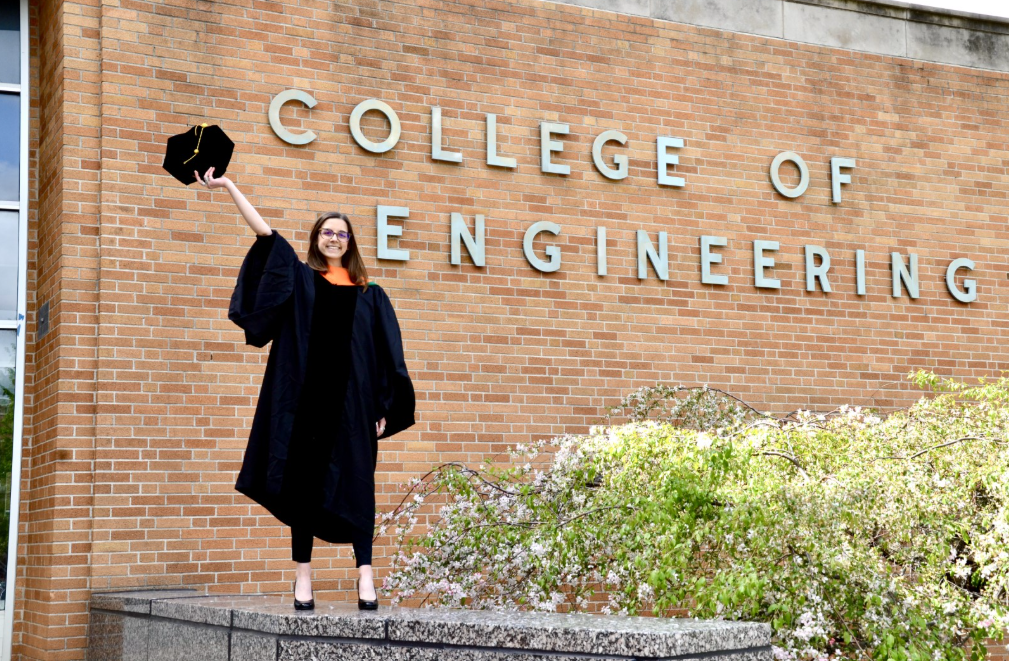
Breakthroughs in research often begin by building on the work that came before. However, as professionals publish an ever-growing body of research articles, keeping up with the output of scientific literature has become a major hurdle. It is increasingly difficult to identify patterns across studies and compare work to previous research. For Emily Bolger, a recent Ph.D. graduate from Michigan State University's Department of Computational Mathematics, Science, and Engineering (CMSE), that challenge became the core focus of her dissertation.
Bolger's research explores how machine learning can help researchers organize and navigate thousands of STEM education articles, making it easier to identify common trends and themes across an endless library of scientific literature. Her research builds on a 2011 study that examined how STEM educators changed their classroom approaches and how those changes improved student learning. A decade later, the research had grown to over 9,000 relevant studies. Before analysis of these papers could begin, researchers had to manually screen thousands of titles to determine which studies were relevant. Those were then narrowed down to 200 papers that required in-depth analysis. Seeking a more efficient approach, Bolger decided to see how a branch of artificial intelligence (AI) called natural language processing could aid in the data sorting process, freeing up the time of highly skilled researchers to conduct detailed analysis on the content of the articles.
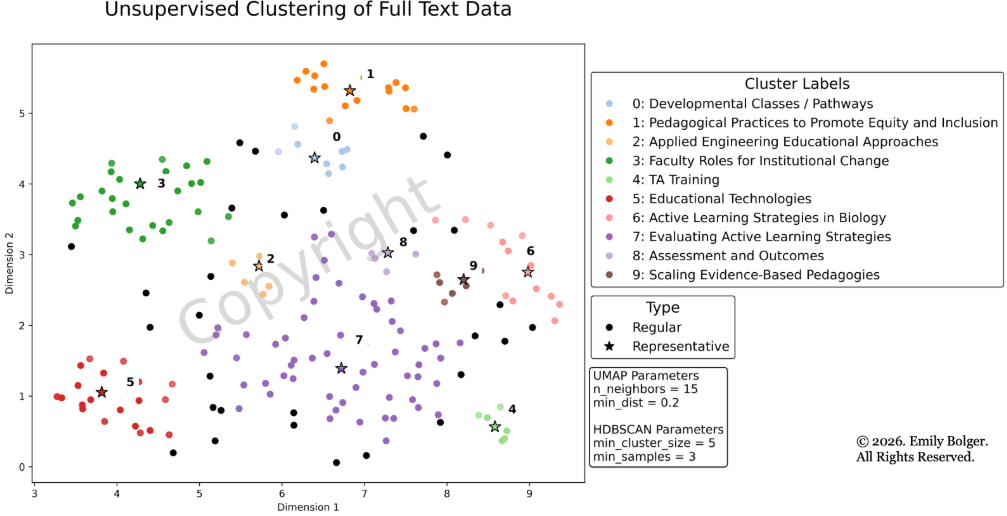
"My dissertation project explored the integration of machine learning methods into the literature review process," Bolger explained. "Could I effectively use things from natural language processing to pull out themes for papers?"
Natural language processing allows computers to understand and analyze written language. Bolger used a machine learning technique known as an embedding to convert each article into a mathematical representation. This allowed the algorithms to group similar papers, giving researchers and STEM educators a framework to identify themes and locate relevant articles more efficiently.
"My work pushed the bounds of what it means to include a human in the loop with AI," Bolger said. "Using the expertise of our qualitative researchers really made the model-building and output stronger."
The idea that AI is most effective when paired with human insight was paramount to her dissertation. While machine learning played a vital role in organizing large amounts of data, researchers remained at the heart of the operation, interpreting the results, evaluating themes, and implementing findings into STEM courses and educational practices.
The process also gave researchers another avenue to identify patterns in STEM education across higher education. Bolger found that her machine learning models could help educators and researchers locate relevant studies more efficiently, potentially informing classroom practices and instructional approaches.
"I don't think it's perfect, and I don't think we should fully trust it," she acknowledged. "But I do think we can leverage the benefits of being able to synthesize large amounts of text very quickly."
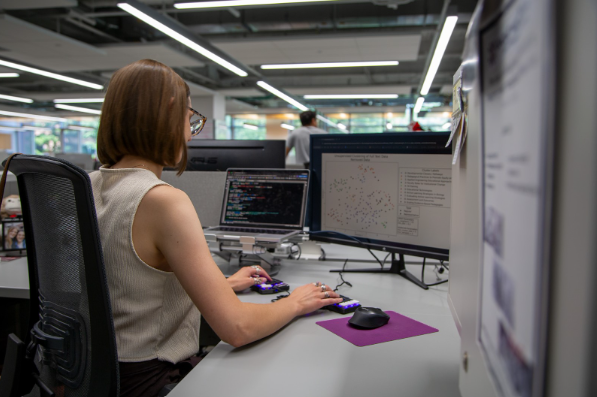
While machine learning tools streamlined her workflows, many models came with computational demands that far exceeded the capabilities of a standard laptop. To overcome that challenge, Bolger turned to the resources provided by MSU's Institute for Cyber-Enabled Research (ICER). ICER's Data Machine allowed her to process embeddings and test clusters of data much more efficiently.
"The Data Machine meant that I wasn't being held up by any sort of computation time," she said.
For Bolger, ICER's impact extended far beyond processing power. User-friendly tools such as the OnDemand graphical interface, which allowed her to avoid working directly in the command line, made advanced computing more accessible. As a result, she could spend more time on her research and less time navigating the technical hurdles often associated with high-performance computing.
"I think it really enables researchers who may not have a good understanding of internal terminal structure to use these complex models," she noted.
Bolger was first introduced to ICER when she participated in the ACRES Research Experience for Undergraduates. The experience sparked her interest in interdisciplinary research and created an early framework for the computational skills she would later develop in graduate school. As her research required increasingly sophisticated computational resources, ICER provided both the infrastructure and support needed to advance her dissertation.
Throughout this process, Bolger discovered that ICER not only provided her with computing systems, but also peers and mentors.
"There's a lot of resources—not just computing resources, but people-resources—that you can leverage,” she explained. “It gives you exposure to what a research project should look like. Even though it seems scary, I think just trying it and using the resources that are available to you is the advice that I would give."
As she prepares to begin a position as a data science preceptor at the University of Chicago, Bolger plans to continue investigating how machine learning can improve STEM education for the next generation. As scientific literature continues to grow, she hopes that researchers will embrace artificial intelligence as a tool for furthering scientific understanding, rather than a replacement for human knowledge.