Modeling Galaxies and Empowering Researchers: A Conversation with Claire Kopenhafer
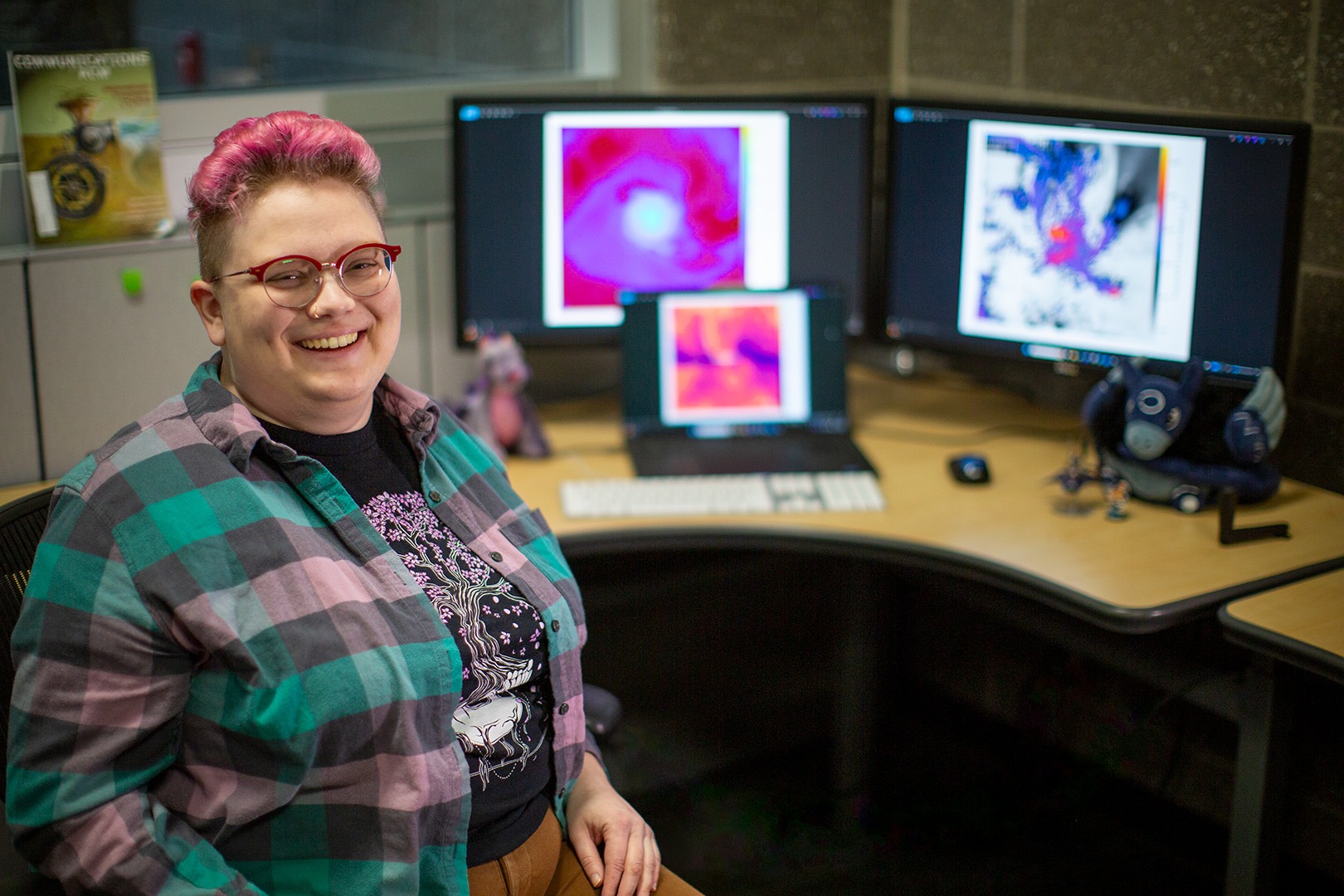
When you ask Claire Kopenhafer what she does at ICER, she often starts with the basics: teaching, coding, and helping researchers solve problems. But the longer you talk with her, the clearer it becomes that her role is much more than that. As a Research Consultant for ICER, Kopenhafer works at the crossroads of science, software, and collaboration, supporting Michigan State University researchers in making the most of computational modeling.
From Astrophysics to Research Consulting
Kopenhafer’s path to ICER began during her time as an undergraduate student in astrophysics at MSU. While she originally envisioned becoming a tenured professor, she realized that the traditional academic route did not align with the type of work-life balance and long-term stability she wanted. What she did know, however, was that she loved parallel computing and had been drawn to computational research since early in her undergraduate years.
“I knew jobs like this existed,” Kopenhafer explained. “I had seen research consultant positions at other universities and thought, that seems like a great fit.”
When a position opened at ICER near the end of her Ph.D., she applied immediately and found the perfect bridge between her strengths in scientific modeling and her desire to support a wide range of research fields.
Modeling “A Universe in a Box”
Although her role now spans many disciplines, Kopenhafer continues to contribute to the FOGGIE Collaboration, a research project that can shed light on why some galaxies form stars while others stop. Using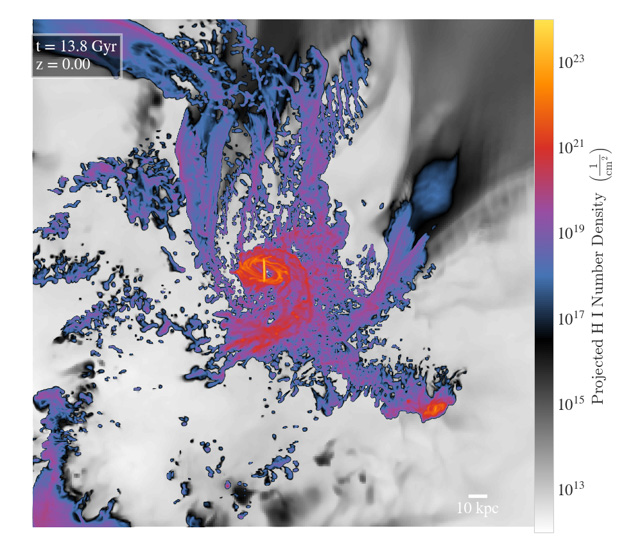 high-resolution simulations, she studies the circumgalactic medium, which is the massive, largely invisible halo of gas that surrounds galaxies.
“If you’ve seen those pretty spiral images of galaxies, that’s only a small part of what’s really there,” Kopenhafer said. “Around it is a much larger region of diffuse gas that helps replenish the galaxy’s fuel for forming stars.”
The collaboration's simulations help examine how this gas flows into galaxies over billions of years, solving longstanding questions about star formation and galactic evolution. For Kopenhafer, this work taps into something deeper: a lifelong fascination with miniature worlds.
“I’ve always loved toy models of things,” she said. “Doing these simulations feels like having my own little universe in a box.”
Helping Researchers Do More Science, Faster
While Kopenhafer’s astrophysics background still plays a role in her work, much of her time at ICER is spent helping MSU researchers across disciplines, from climate science to chemistry to Great Lakes fish population modeling.
Despite the scientific differences between fields, Kopenhafer sees a common thread: “Once you model a system with a computer, you end up using very similar techniques. There’s almost a secret shared language between disciplines that use computational modeling.”
This makes her role uniquely valuable. Many research groups have deep scientific knowledge but less experience with high-performance computing or software optimization. Kopenhafer steps in to fill that gap, whether through one-on-one consulting, collaborative projects, or teaching her graduate Python course.
Students regularly tell her how the strategies she teaches transform their work.
“One student said they use a technique from the first day of class all the time now, and it lets their code run faster and more efficiently,” Kopenhafer said. “All of these tools are about enabling more science and giving people more time to do what really matters.”
Building Worlds: From Simulations to Tabletop Gaming
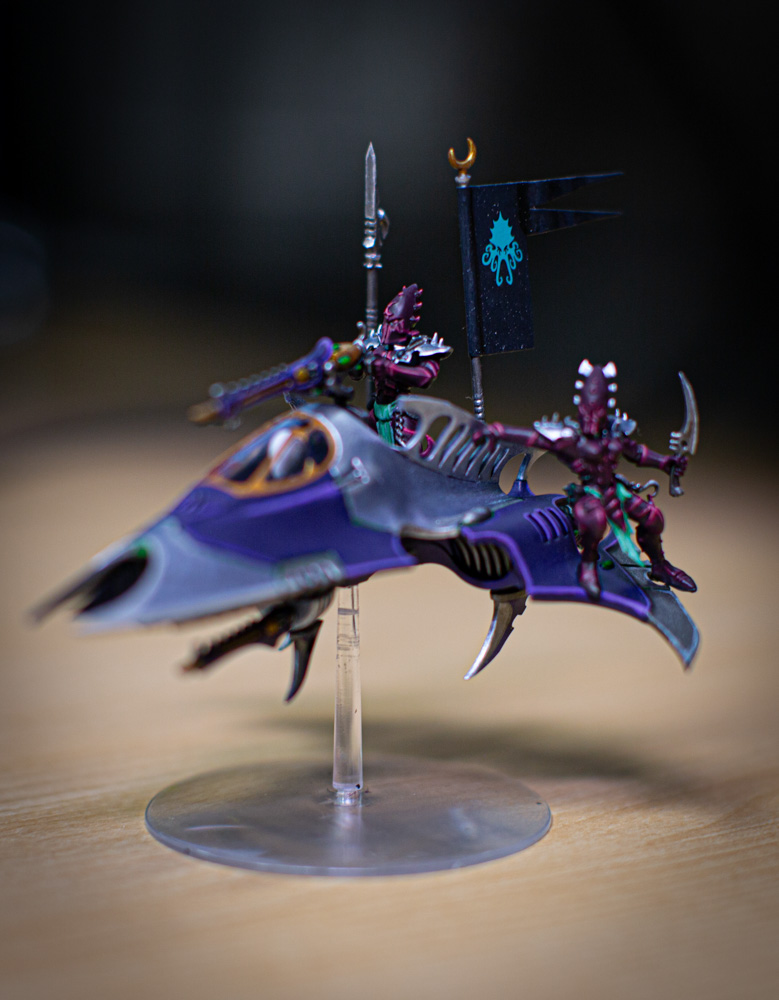
Outside of research, Kopenhafer has an entire creative world of her own. She and her partner are avid board-game players and tabletop wargaming enthusiasts. She loves painting miniatures and dedicates whole days to strategic world-building with friends.
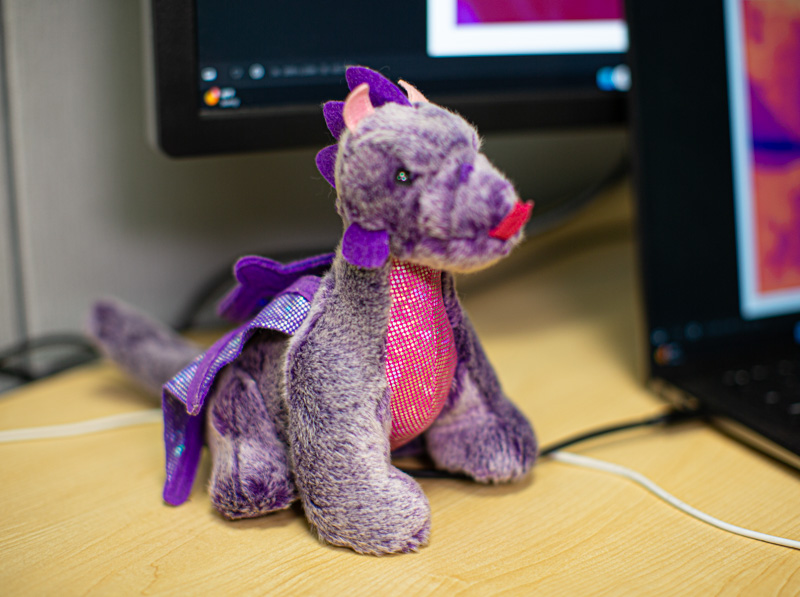
Every Friday, she plays Dungeons & Dragons, and recently completed a four-and-a-half-year campaign full of political intrigue, rebellion-building, and collaborative storytelling.
Her hobby, she jokes, isn’t that different from her work at ICER.
“There’s definitely a connection,” Kopenhafer said. “I’ve always been drawn to tiny models. Now I build worlds at my desk and worlds in my simulations.”
A Connector Across Disciplines
For Kopenhafer, the most rewarding part of her role at ICER is simple: helping researchers succeed. She loves being part of many different scientific journeys, offering expertise that strengthens projects and accelerates discovery.
“I get to see what people across campus are researching and help them do it more effectively,” she said. “I may not want to run my own lab, but I love supporting the incredible work that others are doing.”
Whether she is guiding students through their first steps in high-performance computing or improving code for a climate scientist, Kopenhafer’s combination of curiosity, expertise, and collaborative spirit makes her a driving force behind ICER’s success.